


Introduction: Charting Your US Retirement Journey with ETFs in 2025
Planning for retirement in the United States involves navigating a dynamic financial environment full of hurdles and possibilities. Heading into 2025, Exchange Traded Funds (ETFs) stand out as a vital option for building wealth, combining broad market access, low fees, and easy adjustments to fit your needs. American investors can use ETFs to grow savings during working years and create reliable income streams later on. This guide dives into practical strategies tailored for the US market, covering fund selection, portfolio building, tax strategies, and platform choices to support your long-term goals.

What Are ETFs and Why Are They Key for US Retirement Planning?
ETFs Explained: A US Investor’s Primer
Exchange Traded Funds, or ETFs, pool together assets like stocks, bonds, or commodities and trade on exchanges just like individual shares. What sets them apart from mutual funds is their intraday trading capability- you can buy or sell them anytime the market is open, at real-time prices. This setup lets US investors tap into a wide array of assets through one simple purchase, bypassing the need to pick and manage separate securities.
The Core Advantages of ETFs for Long-Term Retirement Savings in the United States
ETFs shine in retirement planning thanks to features that align perfectly with decades-long investing:
- Diversification Across Asset Classes: With a single ETF, you can spread investments across sectors, regions, or types like US stocks, global bonds, or property. This approach cushions against the ups and downs of any single investment.
- Cost-Efficiency (Lower Expense Ratios): Index-based ETFs often charge far less than managed mutual funds, keeping more money in your pocket to grow over the years-essential for retirement timelines that span decades.
- Flexibility and Liquidity: Trade them any time during market hours for quick tweaks if needed. For retirement, though, holding steady with occasional reviews usually works best to avoid unnecessary costs.
- Tax Efficiency in Specific US Account Types: In regular brokerage accounts, ETFs minimize taxable events compared to mutual funds. Inside IRAs or 401(k)s, gains and dividends grow without immediate taxes, boosting compound returns.
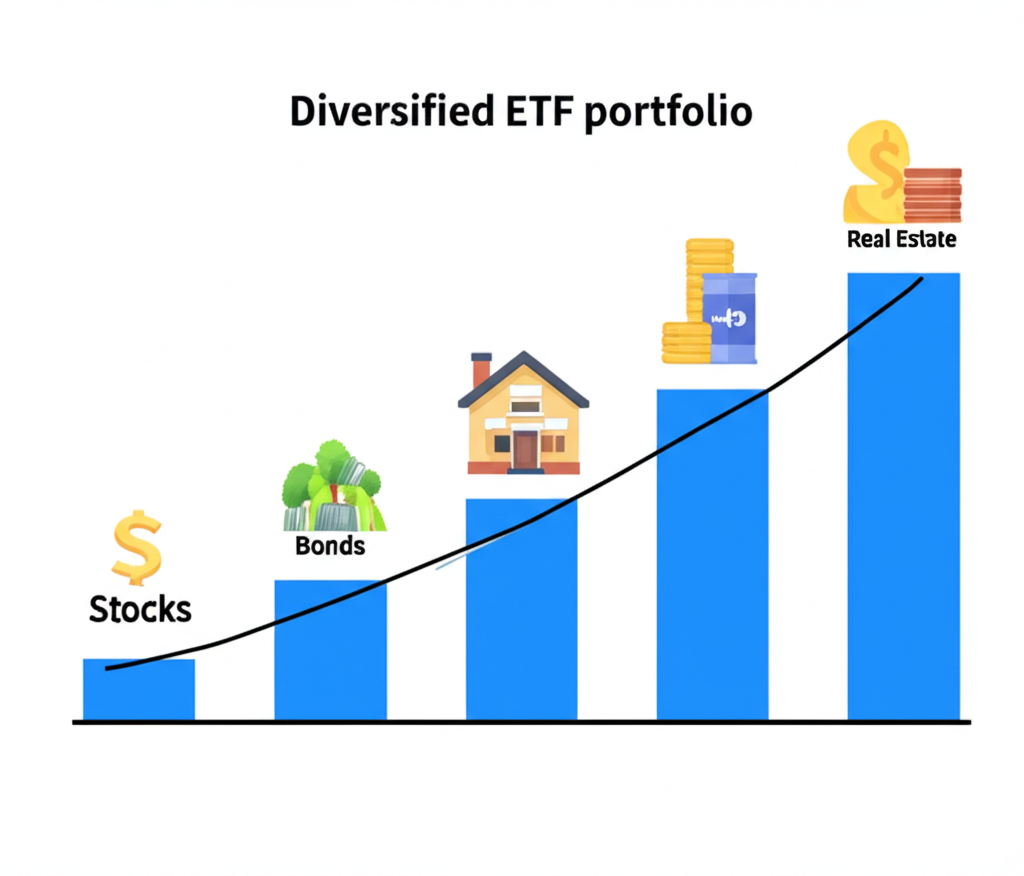
Navigating the ETF Landscape: Types of ETFs for Your 2025 US Retirement Portfolio
Selecting the right ETFs means matching them to your objectives, whether you’re chasing growth or seeking steady payouts. Each type plays a unique role in a balanced retirement setup.
Equity ETFs: Fueling Growth for Your Retirement Nest Egg
These funds focus on stocks to drive appreciation, ideal for those with years ahead before needing the money.
- Broad Market ETFs: They mirror big US benchmarks like the S&P 500 (S&P Dow Jones Indices), the entire US market, or worldwide indexes, spreading risk over many companies. Think of funds like those tracking VOO for the S&P 500 or VTI for total US stocks.
- Sector-Specific ETFs: Targeted at areas like tech, health care, or energy, these can accelerate returns but heighten exposure to industry slumps.
- International/Emerging Market ETFs: Exposure to foreign firms adds global balance and potential from fast-growing regions, balanced against extra market swings.
Bond ETFs: Generating Income and Stability in Retirement
Bond funds hold fixed-income assets for reliable payouts and lower volatility, appealing as retirement nears.
- Government Bonds: US Treasury-focused ETFs deliver top safety and consistent yields with minimal default worry.
- Corporate Bonds: Backed by company debt, they yield more than Treasuries but introduce some credit concerns.
- High-Yield Bonds: Dubbed junk bonds, they promise bigger income at the cost of elevated default chances.
- Municipal Bonds (US-specific tax benefits): These ETFs buy state and local government debt, where interest often skips federal taxes-and sometimes state ones too-for locals. High earners love them in non-retirement accounts for the savings.
Specialized ETFs: Exploring Niche Opportunities (e.g., REITs, Commodities)
For added variety, these ETFs open doors to alternative areas outside plain stocks and bonds.
- Real Estate Investment Trusts (REITs) ETFs: They target real estate firms generating rental income, blending solid dividends with diversification from the broader market.
- Commodity ETFs: Tracking items like gold, oil, or crops, they guard against inflation and add non-traditional balance.
- ESG (Environmental, Social, Governance) ETFs: These pick companies strong on sustainability and ethics, letting values guide your investments without sacrificing returns.
Building Your Ideal ETF Retirement Portfolio: Strategies for US Investors in 2025
Asset Allocation Principles: Balancing Risk and Reward
Smart allocation spreads your money across assets to match your comfort with risk, time until retirement, and aims.
- Diversification Strategies: Mix equity, bond, and international ETFs to cover bases and seize opportunities while tempering threats.
- Risk Tolerance Assessment: Gauge how much market dips bother you. Early savers can lean into stocks for growth; those close to retiring shift toward bonds for safety.
- Age-Based Allocation (e.g., 60/40 rule, target-date funds): A simple guide: equity percentage equals 110 or 120 minus your age. A 40-year-old might go 70-80% stocks, rest bonds. Target-date ETFs adjust automatically, dialing back risk as retirement approaches.
Sample ETF Portfolios for Different Retirement Stages (US Focus)
These examples show how to mix ETFs at various life phases, using familiar options for American savers.
Table 1: Sample ETF Portfolios by Retirement Stage (Illustrative)
| Retirement Stage | Primary Goal | Sample Allocation (ETFs) | Key ETF Examples (US Focus) |
|---|---|---|---|
| Early Career (20s-30s) | Aggressive Growth | 85% Equities, 15% Bonds | Total US Stock Market ETF (VTI), International Stock ETF (VXUS), US Aggregate Bond ETF (BND) |
| Mid-Career (40s-50s) | Balanced Growth & Stability | 70% Equities, 30% Bonds | S&P 500 ETF (VOO), International Developed Markets ETF (VEA), US Corporate Bond ETF (LQD) |
| Pre-Retirement (50s-early 60s) | Preservation & Income | 50% Equities, 50% Bonds | Dividend Growth ETF (VIG), Total US Bond Market ETF (BND), Municipal Bond ETF (MUB) |
| In Retirement (65+) | Income Generation & Capital Preservation | 35% Equities, 65% Bonds/Income | High-Dividend Yield ETF (VYM), Short-Term Treasury ETF (VGSH), REIT ETF (VNQ), Preferred Stock ETF (PFF) |
Image placeholder: Infographic illustrating portfolio allocation shifts across different age groups.
Rebalancing Your ETF Portfolio: Staying on Track
Markets shift allocations over time, so periodic tweaks keep things aligned.
- Why Rebalance: It controls risk by trimming winners and adding to laggards, enforcing a disciplined buy-low, sell-high mindset.
- How Often: Annual checks or when drifts hit 5-10% work for most, avoiding over-trading.
- Methods: Sell excess in hot areas, buy into dips, or steer fresh money to restore balance.
US Tax Implications & Retirement Accounts for ETF Investing in 2025
Taxes can make or break returns, so picking the right US accounts for ETFs matters greatly.
ETFs in Traditional & Roth IRAs: Understanding the Tax Advantages
IRAs offer sheltered growth, perfect for ETF strategies.
- Traditional IRA: Deduct contributions now for deferred taxes on growth; pay ordinary rates on retirement withdrawals. Great if your tax bracket drops later. 2025 limits await IRS updates but build on 2024’s $7,000 base, plus catch-up for 50+.
- Roth IRA: Fund with taxed dollars for tax-free qualified pulls in retirement. Ideal for rising brackets, though income caps limit direct contributions.
- Tax-Deferred Growth: ETFs inside IRAs let dividends and gains compound untouched until (Traditional) or beyond (Roth) withdrawal.
Optimizing ETFs within Your 401(k) and Other Employer-Sponsored Plans
Workplace plans like 401(k)s form the backbone of many US retirements.
- Available ETF Options: Plans often limit to mutual funds, but brokerage windows in some expand to ETFs-ask your admin.
- Rollovers: Job changes let you move 401(k) to an IRA for ETF freedom.
- Tax Implications of Distributions: Defer taxes on contributions and earnings; withdrawals count as income.
Taxable Brokerage Accounts: Strategies for Tax Efficiency with ETFs
Outside sheltered accounts, ETFs still help minimize taxes through smart moves.
- Tax-Loss Harvesting: Sell losers to offset gains or up to $3,000 income yearly; wait 30 days before repurchasing similar funds to dodge wash-sale rules.
- Qualified Dividends: Many ETF payouts qualify for favorable capital gains rates over ordinary ones.
- Capital Gains Considerations: Hold over a year for lower long-term rates on sales. ETFs’ in-kind redemptions cut unwanted distributions versus mutual funds.
Table 2: ETF Tax Treatment by Account Type (US Focus)
| Account Type | Contributions | Growth/Dividends | Withdrawals in Retirement | Key Feature for ETFs |
|---|---|---|---|---|
| Traditional IRA/401(k) | Tax-deductible (may apply) | Tax-deferred | Taxable (ordinary income) | All ETF income/gains accumulate without annual taxation. |
| Roth IRA | After-tax | Tax-free | Tax-free (qualified) | ETFs grow and are withdrawn completely tax-free. |
| Taxable Brokerage Account | After-tax | Taxable annually (dividends) & upon sale (capital gains) | No specific retirement rules | ETFs generally more tax-efficient than mutual funds due to structure; facilitates tax-loss harvesting. |
Risks and Considerations When Using ETFs for Retirement in the United States
ETFs aren’t risk-free; weighing these helps build a stronger plan.
- Market Risk: Broader downturns from recessions or global issues can hit ETF values hard.
- Liquidity Risk (for less common ETFs): Popular ones trade easily, but obscure ones might not, affecting prices on big moves.
- Tracking Error: Fees or operations can cause slight mismatches with the index they follow.
- Expense Ratios and Trading Costs: Even small fees add up long-term; watch commissions unless your broker waives them for ETFs.
- Importance of Due Diligence: Scrutinize holdings, costs, track record, and goals-past performance isn’t a guarantee.
Top Brokerage Platforms for US ETF Retirement Investing (2025 Review)
The platform you choose affects ease, costs, and tools for managing ETFs.
Factors to Consider When Choosing a US Broker for ETFs
Key elements for 2025 include:
- Commission-Free ETFs: Free trades on many funds cut expenses for buy-and-hold strategies.
- Research Tools: Screeners, reports, and planners aid smart picks.
- Customer Service: Quick help safeguards your nest egg.
- Account Types Offered: Cover IRAs, rollovers, and taxable setups.
- User Interface: Simple designs speed up tasks.
- Regulatory Compliance: Stick to FINRA-registered, SIPC-protected firms.
Leading Brokerage Options for Your 2025 ETF Portfolio
These standouts suit US ETF-focused retirement saving:
Table 3: Comparison of Leading Brokers for US ETF Retirement Investing (2025)
| Broker | Key Advantages for US ETF Investors | Considerations |
|---|---|---|
| Moneta Markets |
|
Primarily focused on Forex/CFDs; direct US ETF access may vary or require specific product lines. Best for experienced investors considering a broader range of financial instruments. |
| OANDA |
|
While offering some ETFs, their primary focus remains on Forex and CFDs. |
| FOREX.com |
|
Similar to OANDA, more geared towards Forex and CFDs, with direct ETF access potentially more limited than traditional stockbrokers. |
| Fidelity/Vanguard/Schwab |
|
Might not offer the advanced CFD/Forex trading features some active investors seek compared to specialized platforms. |
Image placeholder: Chart comparing features of top US brokerage platforms for ETF investing.
Conclusion: Securing Your 2025 Retirement with a Smart ETF Strategy in the United States
ETFs will continue powering US retirement plans in 2025, thanks to their spread of benefits from diversification to affordability and adaptability. They fit every phase, from building wealth early on to drawing income post-retirement. Master the ETF varieties, craft a varied portfolio, and use US tax perks to fortify your finances.
Stay committed with routine check-ins and adjustments. This overview sets the stage, but consulting a financial advisor ensures it matches your situation. Pair savvy ETF choices with a solid broker, and your retirement vision comes into clear focus.
Are ETFs a good retirement strategy in the United States for 2025?
Yes, ETFs are widely considered an excellent strategy for retirement planning in the US for 2025 and beyond. They offer diversification, low costs, and tax efficiency, especially when held within tax-advantaged accounts like IRAs and 401(k)s. Their flexibility allows investors to tailor portfolios to different risk tolerances and retirement stages.
What is the 3-5-10 rule for ETFs and does it apply to US retirement portfolios?
The “3-5-10 rule” is not a universally recognized or standard investment rule for ETFs. It might refer to specific, anecdotal advice regarding holding periods or allocation percentages, but it lacks a formal definition in financial planning. For US retirement portfolios, the focus should be on principles like diversification, asset allocation based on age and risk tolerance, and regular rebalancing, rather than arbitrary numerical rules.
What is the $1000 a month rule for retirement and how do ETFs fit in for US investors?
The “$1000 a month rule for retirement” often refers to saving enough to generate $1,000 in monthly income during retirement. While a simplified guideline, ETFs can be instrumental in achieving this. For US investors, a diversified portfolio of income-generating ETFs (e.g., dividend equity ETFs, bond ETFs, REIT ETFs) can provide a steady stream of income to meet such a goal. It requires consistent contributions and long-term growth.
What is the 70/30 rule for ETFs in a US retirement context?
The “70/30 rule” for ETFs in a US retirement context typically refers to an asset allocation strategy: 70% equities (stocks) and 30% fixed income (bonds). This is generally considered a moderately aggressive portfolio, suitable for mid-career investors or those with a higher risk tolerance and a longer time horizon before retirement. It offers a balance between growth potential and stability. As you approach retirement, this ratio would typically shift towards a higher bond allocation.
Where can I find free retirement planning with ETFs resources specifically for the United States?
Numerous free resources are available for US retirement planning with ETFs. Major brokerage firms like Fidelity, Vanguard, and Charles Schwab offer extensive educational materials, articles, and webinars. Reputable financial news websites (e.g., Investopedia, Morningstar) also provide valuable insights. The Securities and Exchange Commission (SEC) and FINRA websites offer impartial investor education. Additionally, many investment platforms, including Moneta Markets, provide market analysis and educational content that can inform your ETF selection and broader retirement strategy, especially for those interested in global market trends.
What are the best ETFs for retirement income in the US for 2025?
For retirement income in the US for 2025, consider a diversified mix of ETFs. Popular choices include:
- Dividend Growth ETFs: (e.g., VIG, SCHD) that invest in companies with a history of increasing dividends.
- High-Dividend Yield ETFs: (e.g., VYM, SPYD) for higher current income, though often with higher volatility.
- Total US Bond Market ETFs: (e.g., BND, AGG) for broad fixed-income exposure.
- Corporate Bond ETFs: (e.g., LQD, VCSH) for potentially higher yields than government bonds.
- Municipal Bond ETFs: (e.g., MUB) for tax-exempt income, particularly beneficial for high-income earners.
- REIT ETFs: (e.g., VNQ) for real estate exposure and often strong dividends.
The “best” depend on your individual risk tolerance and income needs.
How many ETFs should I own in my US retirement portfolio?
For most US retirement investors, you don’t need a large number of ETFs. A well-diversified portfolio can often be achieved with as few as 3-5 core ETFs: a total US stock market ETF, an international stock ETF, and a total US bond market ETF. You might add 1-2 more for specific exposures like REITs or municipal bonds if desired. The goal is adequate diversification, not maximum complexity.
What are the best ETFs for retirees in the United States for 2025?
For US retirees in 2025, the best ETFs prioritize income generation and capital preservation. This often means a higher allocation to bond ETFs and income-focused equity ETFs. Consider a mix of:
- Short- to Intermediate-Term Bond ETFs: (e.g., VGSH, BND) for stability and lower interest rate risk.
- Dividend ETFs: (e.g., VYM, SCHD) for consistent equity income.
- Preferred Stock ETFs: (e.g., PFF) for hybrid income securities.
- Municipal Bond ETFs: (e.g., MUB) for tax-efficient income if you are in a higher tax bracket.
Platforms like Moneta Markets offer advanced analytical tools that can help retirees monitor market conditions and make informed decisions on their income-generating ETF portfolios, especially if they are interested in instruments that react to global economic shifts.
 English
No responses yet